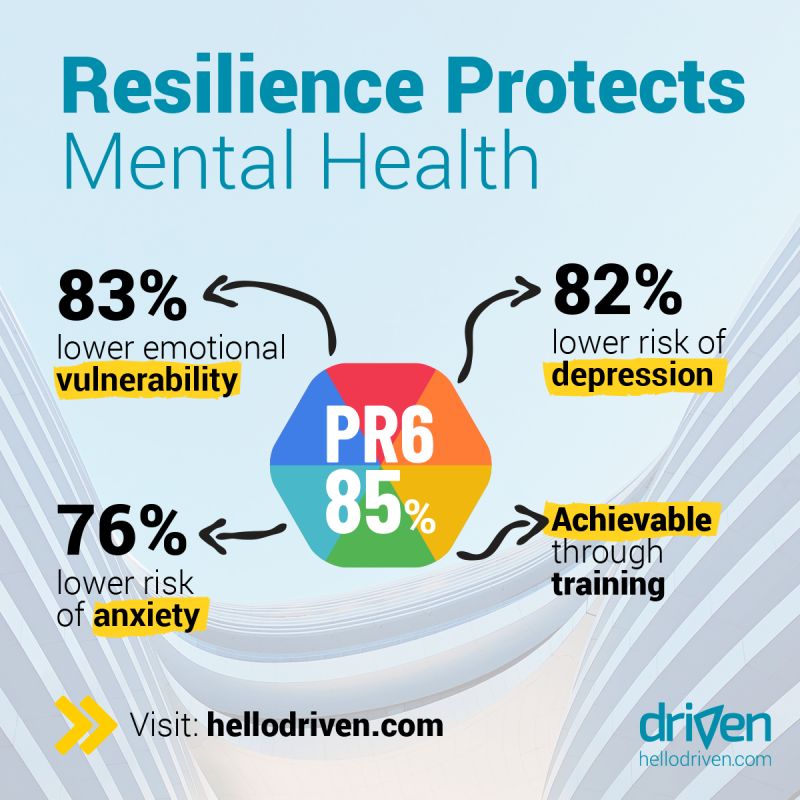
Resilience Protects
Resilience Protects Mental Health
How can we protect our mental health?
What would you, your workplace and our communities look like if we could achieve these results?
82% less chance of Depression. 75% less chance of Anxiety. 83% lower emotional Vulnerability.
Resilience is often described as the ability to “bounce back” from adversity. But resilience goes much deeper than recovery.
The PR6 (Predictive 6 Factor Resilience Model) defines resilience as:
A measurable and trainable set of factors that predict an individual’s capacity to manage stress and protect their mental health.
This is what sets PR6 apart—it’s not just descriptive, it’s predictive and preventative.
Rather than waiting until someone is struggling, the model identifies which areas of resilience need strengthening to reduce the risk of mental ill-health before it occurs.
The 6 Domains of the PR6 Model
1. Vision
A clear sense of purpose and direction
Vision refers to your ability to define meaningful goals and align them with your values.
When individuals lack direction, uncertainty increases—and so does psychological strain. A strong sense of vision provides clarity and motivation, especially during challenging periods.
How it protects mental health:
Creates a sense of meaning and direction
Supports motivation and goal progression
Helps individuals navigate uncertainty with confidence
2. Composure
The ability to regulate emotional responses
Composure is your capacity to remain calm and manage emotional reactions under pressure.
It’s not about avoiding stress, but about responding in a controlled and constructive way.
How it protects mental health:
Reduces emotional reactivity
Helps prevent stress escalation
Supports clear thinking in high-pressure situations
3. Reasoning
Flexible and accurate thinking under pressure
Reasoning relates to how effectively you process information, solve problems, and maintain perspective.
Individuals with strong reasoning skills are less likely to fall into negative thinking patterns and more likely to approach challenges constructively.
How it protects mental health:
Minimises unhelpful thought patterns
Encourages solution-focused thinking
Builds confidence in decision-making
4. Health
The physical foundation of resilience
Health reflects your ability to maintain energy, recovery, and overall physical wellbeing.
This includes sleep, nutrition, and physical activity—all of which directly impact cognitive and emotional functioning.
How it protects mental health:
Supports emotional regulation
Improves stress tolerance
Enhances overall cognitive performance
5. Tenacity
Persistence and follow-through
Tenacity is your ability to stay committed and take action, even when things are difficult.
It reflects discipline, motivation, and the capacity to push through challenges rather than avoid them.
How it protects mental health:
Builds a sense of achievement and control
Reduces avoidance behaviours
Reinforces confidence through progress
6. Collaboration
Connection and support networks
Collaboration refers to your ability to build relationships, seek support, and work effectively with others.
Resilience is not an individual effort—social support plays a critical role in protecting mental health.
How it protects mental health:
Reduces isolation
Provides emotional and practical support
Strengthens a sense of belonging
Why the PR6 Model Matters
What makes the PR6 model particularly powerful is its interconnected structure.
Each domain influences the others:
Poor Health can reduce Composure
Lack of Vision can weaken Tenacity
Limited Collaboration can increase stress and isolation
By measuring these domains, organisations and individuals can:
Identify early signs of risk
Take targeted action
Build resilience proactively—not reactively
Final Thought
The Driven PR6 model reframes resilience from something abstract into something practical, measurable, and actionable.
It shifts the question from: “Am I resilient?”
to
“Which areas of my resilience can I strengthen to better protect my mental health?”
And that shift is what enables real, lasting change.